Mechanics — The Missing "Why" of ND Experience
Following the Laws of Mechanics Creates Neuro Balance
The functional laws of mechanics are the baseline for achieving neuro balance.
When neuro balance is achieved, your system moves out of chronic micro‑threat mode and into regulated coherence.
When your nervous system is balanced, everything becomes easier: your focus sharpens, your energy stabilizes, and your emotions settle.
When neuro balance is achieved, you gain access to a new way of living: clearer thinking, smoother transitions, steadier energy, deeper rest, and the ability to shift your state on purpose — not by accident. From this baseline, state‑change tools become reliable, predictable, and effective — just as they are for neurotypical nervous systems.
What Mechanics Actually Are
Mechanics are the functional laws that govern how your system operates. They describe how your brain behaves under load, in different environments, and across different states. Mechanics are not the same as architecture.
Architecture is the structure of your system.
Mechanics are the functions that operate within that structure.
Mechanics explain the behavior of the architecture.
They show you why your system reacts the way it does — without shame, judgment, or moral interpretation.
Why Mechanics Matter
Most ND people are taught to focus on symptoms or behavior. Mechanics give you the missing layer underneath:
- why clarity appears and disappears
- why energy drops suddenly
- why some environments drain you
- why task initiation fluctuates
- why "trying harder" doesn't change anything
Mechanics give you the why behind your experience. They turn confusion into coherence.
Mechanics vs. Architecture
To keep the distinction clean:
Architecture = structure
- working memory capacity
- sensory thresholds
- pacing needs
- environmental scaffolding
- energy‑flow channels
Architecture defines the shape of your system.
Mechanics = function
- how patterns form
- how gaps appear
- how bridges restore alignment
- how activation happens
- how energy moves
- how clarity collapses or returns
Mechanics describe the laws of operation.
Architecture shapes mechanics.
Mechanics reveal how the architecture behaves.
They are interdependent, but not interchangeable.
Mechanics vs. Symptoms
Symptoms describe what you see.
Mechanics describe what's causing it.
Symptoms say:
- "I can't focus."
- "I'm overwhelmed."
- "I can't start."
- "I shut down."
Mechanics say:
- working memory is overloaded
- the environment is unclear
- the system lacks a bridge
- energy‑flow is depleted
- the architecture is mismatched
Symptoms are surface.
Mechanics are structure‑in‑motion.
The Four Core Mechanics of the ND Operating System
These four mechanics form the backbone of Sunny's ND OS:
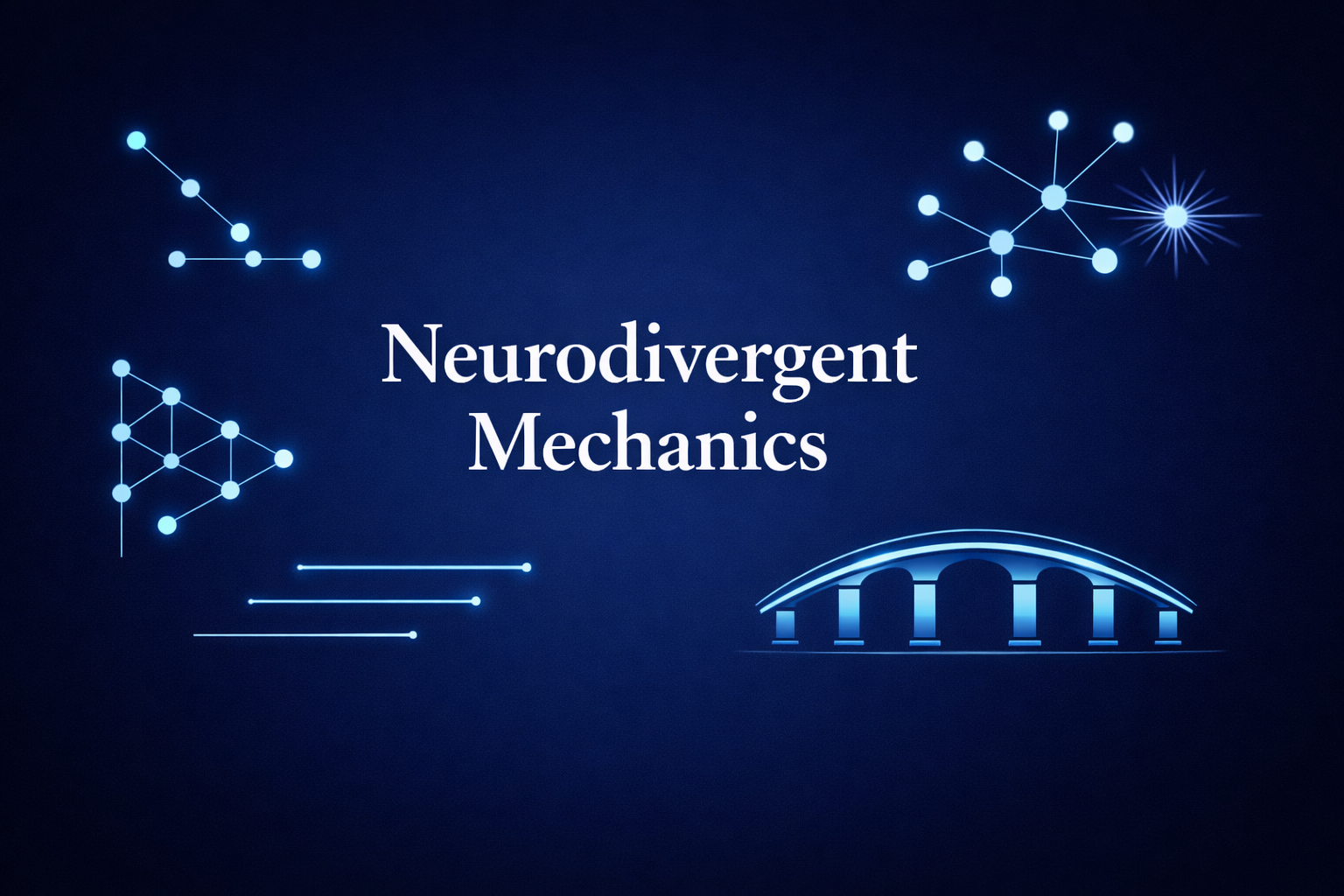
1. Pattern - what the system is doing
The observable behavior or state.
Patterns are mechanical, not moral.
2. Gap - what's missing or misaligned
The structural absence that creates friction.
Gaps are architectural mismatches, not personal failures.
3. Bridge - the structural correction
The adjustment, support, or environmental shift that restores alignment.
Bridges reduce load and restore clarity.
4. Activation - the moment the system comes online
When the architecture matches the mechanics, the system activates.
Clarity returns. Capacity expands. Energy flows.
This is the ND OS in motion.
How Mechanics Create Clarity
Clarity appears the moment you can see the mechanics underneath the experience. For example, if you “can’t start” a task, it looks like procrastination on the surface. But when you look mechanically, you see the real pattern: the task has no defined edges, the steps are not visible, and your system has nothing to lock onto.
Once you name the gap - “there is no starting point” - the pattern becomes workable. Adding a bridge like a single visible first step instantly reduces load. The system reorients, and clarity returns.
Mechanics turn invisible processes into visible patterns - and once you can see the pattern, you can work with it instead of against it.
How to Use Mechanics to Keep the Nervous System in Natural Alignment
When you understand your mechanics, you stop fighting your system and start working with it. Alignment becomes a daily practice of noticing patterns, naming gaps, and adding the smallest bridge that restores flow. This keeps your nervous system in its natural rhythm - clear, grounded, and responsive instead of overloaded or shut down.
The practical benefit is immediate: less time wasted, less effort spent, more energy available, and far less friction. Mechanics give you a way to stay in alignment without forcing anything - your system simply comes online when the structure matches what it needs.
The Transition: From Mechanics to Belonging
Why Mechanics Are Only the Beginning:
Mechanics give you the structure your system has always needed - the why behind your patterns, the architecture beneath your experience, the clarity that returns the moment the system is understood instead of judged.
Mechanics restore internal alignment. Community sustains it.
If the Mechanics page helped you see your system more clearly, the next step is stepping into a space built for ND architecture - a place where you can explore your patterns, name your gaps, build bridges, and experience real activation alongside others who are doing the same.
The Community Page is where that begins.
It’s the doorway into the community — a place designed for ND nervous systems, ND pacing, ND communication, and ND mechanics. A place where your architecture is not only understood, but matched.
If you want to explore your patterns, name your gaps, and build the bridges that keep your system in alignment — you can step into the next phase here:
© 2026 NeuroBalance Now. All rights reserved.