Working Memory, The Mechanical Bottleneck at the Center of the ND Experience
The structural explanation of how ND cognition holds, loses, and restores the thread.
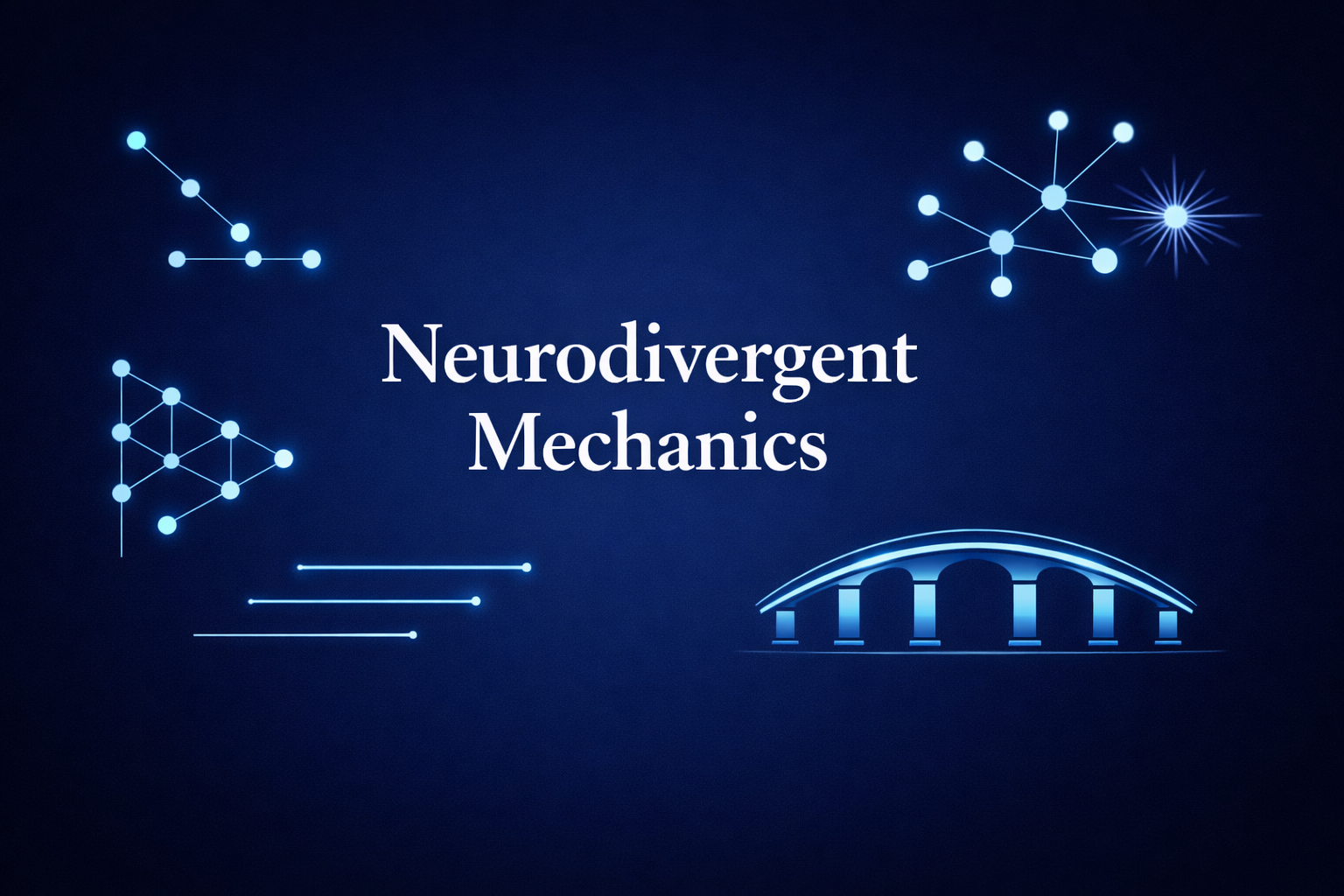
The Four Core Mechanics of the ND Operating System
The ND OS is built on four universal mechanics that describe how ND cognition works. Pattern is how the mind organizes information and detects meaning. Gap is where breakdowns, overloads, and misinterpretations occur. Bridge is the supports, structures, and tools that stabilize the system. Activation is the moment insight becomes action - the system comes online when the environment carries enough of the weight for your mind to move.
Working memory sits inside this architecture. It is the mechanical bottleneck that determines whether a pattern can be held long enough to activate.
Pattern
1. The Elephant in the Room
Working memory is the one part of ND life that cannot be hidden, masked, or explained away. It shows up in real time. It drops in real time. And ND people feel it immediately and it is noticeable by others.
Before anyone gives them language for it, they assume the worst:
- Why can’t I hold onto this thought
- Why did it just disappear
- Why do I lose the thread so fast
- Why can everyone else do this
My brain must be broken.
Not because it is broken, but because no one ever explained the mechanics.
2. What Working Memory Actually Is
Working memory is not focus or attention. It is the part of your mind that holds information long enough to use it.
For ND people, working memory is:
- capacity limited
- easily overloaded
- sensitive to meaning
- sensitive to emotional tone
- sensitive to the environment itself
- inconsistent across contexts
It is not the more stable memory of the neurotypical model. It has a conditional buffer. It only turns on and operates efficiently when the conditions are right. This is mechanics, not deficiency.
3. ND vs NT Working Memory
This is not about who is better. It is about how the systems are built.
NT working memory
- steady
- linear
- detail friendly
- predictable
ND working memory
- context dependent
- meaning gated
- pattern driven
- easily disrupted by irrelevant detail
ND working memory collapses under low meaning tasks and becomes powerful under high meaning tasks. This is not inconsistency. It is simply different structure.
4. What the Collapse Feels Like
Every ND person knows this feeling:
- the sudden blank
- the lost thread
- the “what was I just doing”
- the “I knew this ten seconds ago”
- the freeze when someone gives multi step instructions
- the panic spike when the buffer empties
It is not a failure of intelligence. It is not a lack of effort. It is the buffer dropping because the load exceeded its design.
Gap
5. The Misinterpretation Loop
Because no one explains working memory, ND people learn to blame themselves.
- When working memory collapses
- They feel the drop
- They assume it is their fault
- They try harder
- They burn out
- The collapse happens again
- Shame builds
Over time, this becomes:
- I am unreliable
- I am forgetful
- I cannot trust myself
- I must be broken
But the collapse was never personal. It was mechanical.
6. The Real Why
ND working memory is conditional, not defective.
It works when:
- the task has meaning
- the information forms a pattern
- the environment is calm
- the emotional tone is safe
- the person is engaged
It collapses when:
- the task is low meaning
- the environment is chaotic
- the emotional tone spikes
- the information is detail heavy
- the person is interrupted
This is predictable. This is explainable. This is normal for ND architecture.
Bridge
7. What Stabilizes ND Working Memory
These are not hacks. These are mechanical supports that hold the thread when the buffer cannot.
- External scaffolding: A written note holds the thread when a conversation interrupts you.
- Visual anchors: A container for keys holds the memory, so your brain does not have to.
- Predictable environments: Quiet rooms stabilize the buffer. Noisy cafés collapse it.
- Emotional safety: Calm tone supports clarity. Tension empties the buffer instantly.
- Interest and meaning: High meaning tasks activate the buffer. Low meaning tasks collapse it.
- Tools that hold the thread: Summaries and lists act as external working memory. (This is where AI assistance can really be helpful.)
These supports do not fix anything. They match the architecture.
8. What Overloads ND Working Memory
These are predictable triggers. When they stack, the buffer drops.
- Multi step verbal instructions: Verbal sequences exceed the buffer.
- Time pressure: Urgency spikes the load and blanks the mind.
- Interruptions: A single question can erase the entire thread.
- Noise: Background sound consumes working memory capacity.
- Detail heavy information: Twenty form fields overload the system. Three do not.
- Task switching: Rapid task switching without an orientation thread, collapses context.
When these pile up, the buffer drops every time.
ND STRENGTHS THAT EXIST BECAUSE OF THIS ARCHITECTURE
9. ND Strengths Are Hidden in This Architecture
The same architecture that struggles with small details excels at high meaning, high pattern tasks.
- Pattern recognition: You see underlying structures instantly.
- Systems thinking: You understand how moving parts interact.
- Future mapping: You sense where situations are heading early.
- Intuitive leaps: You jump from A to Z through pattern compression.
- Creative problem solving: You generate solutions that do not exist yet.
- Emotional ecosystem tracking: You sense shifts before others notice them.
- Connecting dots: You link ideas across frameworks through meaning.
These strengths exist because the brain is optimized for meaning, not minutiae. The weakness and the strength come from the same source.
10. How to Explain ND Working Memory to Others
“My brain does not hold small pieces of information unless they have meaning. If you give me steps, I will need them written down. If you interrupt me, I will lose the thread. It is not about effort. It is how my brain is wired.”
This reduces friction instantly.
11. The Working Memory to Shame to Burnout Cycle
- Working memory collapses
- You blame themselves
- You push harder
- You mask
- You burn out
- You recover
- The cycle repeats
Once you understand the mechanics, you break the burnout cycle.
12. The Reframe
You were never broken. Your working memory was never a flaw. It was a design that no one explained to you.
Once you understand the architecture, everything makes sense:
- the inconsistencies
- the overwhelm
- the “I can do this but not that”
- the shame
- the burnout
- the brilliance
This is not a character issue. This is not a motivation issue. This is not a discipline issue. This is mechanics.
Activation
13. How This Fits Into the ND OS
Working memory is not a side note. It is one of the core pillars of the entire system.
- Activation: When working memory is supported, activation becomes possible. Without support, activation stalls because the thread cannot be held long enough to begin.
- Frequency: Emotional tone directly affects working memory. A calm frequency stabilizes the buffer. A spike collapses it.
- Capacity: Working memory is the front door of capacity. When it is overloaded, capacity appears low even when the person has high potential.
- The deactivation loop: A working memory collapse often triggers the loop. Drop, shame, freeze, shutdown. Understanding the mechanics interrupts the loop cycle.
- Energy flow regulators: Tools, routines, and environmental structures regulate the load on working memory. They prevent unnecessary drops.
- Acute to chronic patterns: Repeated collapses without explanation create chronic shame and self-doubt. Naming the mechanics reverses the pattern.
- The ND OS manual: Working memory is the hinge point between pattern recognition and activation. It determines whether insight becomes action.
Aligned Working Memory
How Stabilized Working Memory Responds
When working memory has the right conditions, the whole system reorganizes around possibilities. Working memory stops collapsing. Thoughts hold. Insight stabilizes. The scaffolding holds the load, the pieces move where they need to move, and activation becomes a natural expression of your system. This is where ND cognition shows its full strength - without struggle, because it is in alignment.
The outcome:
You move through your world with more coherence, more ease,
and more access to the strengths that were always there.
© 2026 NeuroBalance Now. All rights reserved.